Happy Habitiversary to Me!

Today marks the one year point for when I set my first habit goals and set up a spreadsheet to track them . I’m calling it my habitiversary. I’m not sure I like the term; let me know if you think of something catchier ;).

I started with a just a couple, and now I have a color-coded rainbow spreadsheet to track many habits across many areas of my self-care. Not to mention a blog, and a series on how to help others get started making successful habit changes.

When I started last year, deciding to track healthy habits instead of a number on a scale or clothing size was unfamiliar territory for me. I decided I wanted to be open to whatever outcomes would come.

Continue reading

What’s In My Newsfeed?

Earlier this year, I came upon a blog post titled “How to Break Your Body Shaming Habit.” It was since removed from the website that posted it, but I managed to find an excerpt. The blog post promised that there was something someone did, in just 15 minutes, that helped her end her body shaming habit. Not 15 minutes every day. 15 minutes, PERIOD.

She changed whom she followed on Instagram.

“I realized I was looking at certain women in my Instagram feed and feeling bad about my body,” she says. “So I unfollowed them and followed more women who were beautiful, but in a wider variety of shapes, sizes and colors. I just added more variety to the images I was seeing every day when I scrolled through my phone.”

After a few weeks, she also started following women who were doing things with their bodies that she wanted to do. Strong things. So she followed Olympic weight lifters. Javelin throwers. Women doing handstands and flipping logs.

“I was enjoying following them so much that the ‘fitspiration’ crap on my Pinterest board started looking stupid. Those women were just skinny and sweaty. So I started unfollowing them, and my Pinterest board started to look like my Instagram feed. And I was feeling even better about myself.””

I love this advice. I also did this early last year, and I highly recommend it. With that in mind, I thought I’d share some of my favorite groups, people, and pages I follow on Facebook. I’m not on Instagram, but many of these pages have Instagram counterparts as well.

Continue reading

My 2016 Habit Goals Unveiled

I haven’t posted in a while. My husband has been bedridden with a fractured patella and I have not-so-quietly been going insane.  Today bedridden husband I are both sick. So my parenting consists of letting my kid binge watch his Christmas present (Rachel and the Treeschoolers). And telling him that I will turn it off if he doesn’t throw the trash IN THE TRASH.

While my kid is learning science concepts from Rachel, I finished up my goals list for 2016.  I added a couple new habits to work on, reset my goals for the habits I am continuing in 2016, and set a couple reasonably achievable goals that are one-time events, not habits.

Here they are!

Continue reading

Training Log: Appreciating the Convenience of a Living Room Gym

One of the really great things about having moved my porch gym into the living room for the winter is that getting a workout in no longer requires as much preparatory work.  Any parent with a gym membership can attest to the fact that it can be a lot of work to get yourself and your kid dressed, diapered, fed, lunch packed, and out the door to the gym. Today I felt pretty depleted from a high stress week (my husband broke his kneecap in a bicycle accident, and my kiddo was sick). I was feeling pretty grumpy and tired this morning, and I probably wouldn’t have gotten us out the door to go to the gym, even though I had a workout planned. I was considering skipping it.

But, since the gym is now my living room, I simply got dressed in my workout clothes, in case I decided to lift. Then we ate breakfast, and I put on a movie for my kid because I was way too grumpy and stressed to mentally engage….and then decided to put on my shoes and warm up.

Continue reading

The Rainbow Spreadsheet! (Habit Tracking Template)

I just set up my habit tracking spreadsheet for 2016, with updated habit goals.  Since I’ve been doing this for a year now and have accumulated a bunch of habit goals (one or two at a time!), I decided to group them by categories and color code them.

I shared a screenshot of my spreadsheet in a few habit groups.

Habit Sheet

(You’ll have to settle for a crappy screenshot, because I have zero photoediting skills and can’t figure out how to sharpen the image if I expand it).

In one group in particular, people got really excited and asked me if they could share and use for educational purposes. Presumably they also loved my broad based view of health and realistic goal setting, not just the pretty colors. So, I edited my template so you can download it and edit it for your own use. (The first tab in the document is an example of what the set up looks like for a first-time habit tracker. The second tab has “the rainbow spreadsheet,” an example of what it looks like for a second-year habit tracker – me!).

Now…..here is the really important thing. I KNOW EVERYBODY LIKES RAINBOWS and gets super excited and wants a rainbow spreadsheet of their very own.

I urge you all to read through my entire sustainable habit series, starting with Part I, to help guide you in getting started. If you do that, your spreadsheet might look awfully monochromatic for a few months. Be patient. Don’t rush things. You too can have a rainbow spreadsheet soon! In fact, you can have one now and I can’t stop you. But I highly recommend you read all the background info and start with just one habit. Because ultimately, what’s more exciting? A rainbow spreadsheet NOW, or actual success (however you define it), and a rainbow spreadsheet later?

And yes, I’m totally okay with people sharing this post and using it for personal and educational purposes, as long as you credit Power, Peace and the Porch Gym.

Open the Power, Peace and the Porch Gym habit tracking template (aka “The Rainbow Spreadsheet”)

Enjoy, and happy habit forming!


As it Turns Out, The Water Is Fine.

A couple weeks ago I wrote a post about a new habit I had started that was provoking some conflicted feelings. A month has gone by since I started this habit, and I’ve been having some thoughts and feelings I wanted to document before I forget about them. So, you get a post! Yay!

The habit goal I am writing about is “finish my food by 8pm, 25 times by the end of the year.” I was experiencing both optimism and apprehension about adopting this habit. My biggest fear was that a habit like this would send me back into a dieting/restriction oriented mindset.

Overall, this habit is going a lot better than I expected, both in terms of emotional response and implementation.

Continue reading

Shit’s About to Get REAL BORING

If you weren’t already bored with this blog, things might be changing soon.

I’m already kinda bored.  Not in a bad way. But definitely in an unfamiliar way.

Last December when I set my goals for 2015, I was super excited about them! New habits! This was novel and exciting and interesting! Habits I could actually stick to! Habits that didn’t have shame and guilt attached to them! Goals where success wasn’t measured by how close I was to some arbitrary outcome I had chosen!!!

This year I had amazing success with so many habits. I’ve already reached or surpassed 5 of the habit goals I set, and the year isn’t yet over. My general happiness level is so much higher. My perspective is so much more gentle towards myself and others. My spending and saving habits are improving. My marriage habits are improving. I found a fun hobby so I could stop obsessing over every little parenting detail. My back pain disappeared. My blood work numbers have all improved. My home sparks much more joy and I love spending time here now. I am more relaxed around food than I have ever been in my entire life. My mental clarity is much better and brain fog is no longer something I struggle with often. My strength has surpassed my pre-pregnancy strength levels.  Depression is gone.

That’s a pretty damn big deal. Now what for 2016?

Continue reading

How to Set a Sustainable Habit Goal This Year: Part III

This post is Part III of a series. If you haven’t already read Part I and Part II, you’ll want to do so before reading this post.

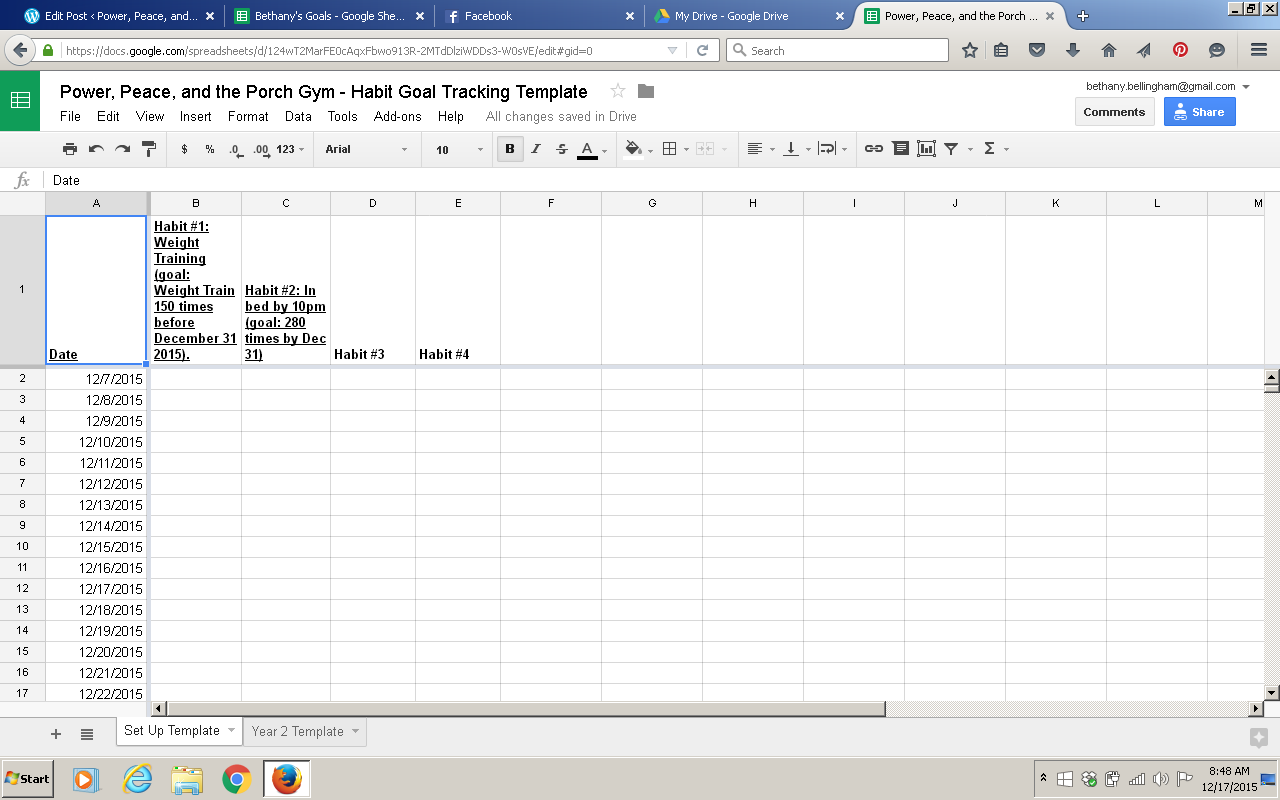
This post will cover how I set up my habit tracking spreadsheet, how I track my habits, and how and when I know to add more habits.

I get a lot of questions on how I track my habit goals. This post is not a comparison of different methods, as I only tried one, and it works for me. I know there are habit tracker apps available, and I can’t comment on how they work, because I haven’t tried them. If you find one that you like, I’d love for you to show me sometime, just for curiosity’s sake. This method works great for me. Don’t be intimidated by the initial set-up. After you set up the spreadsheet for the first time, it takes less than a minute per day to track your habits. Really.

Step 3 – Set Up Your Habit Tracking Spreadsheet

You’ll need a spreadsheet program. It doesn’t matter if it is Microsoft Excel, OpenOffice Calc, or Google Sheets. I prefer Google Sheets because I can then access my spreadsheet from any device. If that isn’t important to you, use any spreadsheet program; it doesn’t matter which.

You can even copy my spreadsheet.

Screenshot 2015-12-17 08.48.01

Screenshot 2015-12-17 08.51.20

If you prefer to set up your spreadsheet from scratch, and can follow written directions well, here are the steps:

  1. Open a new document.
  2. Label the rows as follows: in cell A1, enter “Date.” This is your heading. In cell A2, enter your starting date (I highly recommend today’s date!). In cell A3, enter tomorrow’s date. Use your spreadsheet skills to drag it on down, so each day is the next day in the year. Stop when you hit the end date for your goal time frame.
  3. Label the columns as follows: in cell B1, enter your habit goal (example: Do a weight training workout 150 times by December 31). If you are working on a second habit (possibly not a good idea, but I did it and lived to tell the tale), enter that habit goal into cell C1.  (If/when you add other habit goals, you will enter them into  cells D1, E1, F1, etc).
  4. Go back to column A. Scroll down to the last row that is labeled with the end date for your goal time frame. In the row below that one, enter “Total”.
  5. Go to the “B” cell in that row. Enter a sum formula. (If you did your spreadsheet correctly, it will probably look like =SUM(B2:B365). The ending number may be a little different; just adjust the number to take all the cells into account. If you need help, ask me. Or ask someone good at spreadsheets that you know in real life.

If you are good at spreadsheets, put in percentage formulas below the total column. Then you will be able to see how close you are to accomplishing your goals.

Step 4 – Track Your Habit!

Once your spreadsheet is set up, here’s how to track your habit.

On each day, go to the row labeled with that day’s date. In each habit column, enter “1” if you did the the habit. If you didn’t do the habit, don’t enter anything.

THAT’S IT!!!!

If your sheet is set up correctly, your totals should calculate at the bottom in the “Total” row.

Step 5 – Adding More Habits

Another common question is “how often do you add new habit goals?”

I typically add new habit goals every 3-8 weeks, depending on how solid I am feeling with the habits already on my plate. The commonly quoted “it takes 21 days to make a habit” is not quite wrong; it’s more like a half-truth. It can take anywhere from 21 to 254 days to form a habit.

I have found that some habits are easier than others to establish. For example, remembering to take my Vitamin D was easy: once I added it to my spreadsheet, it gave me a daily reminder to take it, so that habit formed pretty quickly. Habits that take more time and planning may take more time to solidify. For example, movement habits or cooking habits may require more planning and more practice overcoming obstacles before they are really solidified.

My best advice is to be honest with yourself. How solid do you REALLY feel with your habit? Once you feel pretty solid, it may be time to consider adding a new habit. If you read Part I of this series and came up with a list of habits you wanted to try, just look at the list and choose the habit that you WANT to work on most, and add that one.  Go back to step 1, and repeat the steps as needed.

As I added more habits, I added them to my spreadsheet. You can even categorize and color code them, if it makes you happy. (See the second tab in the spreadsheet linked).


A Possibly Optional, but Highly Recommended Step

I’m not technically sure this step is optional, since I used it. I feel this step has been key to my success. However, I can’t swear that it MUST be used.

This step is practicing self-awareness. During the year, as you practice your habits, notice how you are feeling. Before, during and after doing your habits. As you track them. Always ask yourself if the habits are enriching your life, or making it worse. Adjust accordingly if needed.

If you are new to my blog, here are some of my previous posts on habits.  These will give you an idea of how the past year has looked for me as I focused on building habits, and where and how I used self-awareness to modify as needed.

This concludes my series on setting sustainable habit goals….for now. If you have a question I did not address, leave a comment! I’ll be happy to answer questions in a follow up post. Happy habit forming!


How to Set a Sustainable Habit Goal This Year: Part II

Welcome back! This post is Part II of a series on how I set my habit goals. If you haven’t already done so, read Part I first.

Step 2 – Choose a Time and Frequency Goal for your Habit

I answered a LOT of questions this past year about this step.

For all my habit goals, I defined a specific frequency and time frame. For example:

  • Do a strength workout 150 times this year.
  • In October, I set a goal to deposit $10 into my emergency fund 15 times by the end of the year.

One of the most common questions I am asked was “how do you decide how many times you are aiming to do your habit?”

How do you decide on a time frame?

I’m going to go over time frame before frequency, because that is easy.

I am a HUGE fan of doing a year-long time frame, for several reasons:

  • the whole persistence thing quoted in part I. If we feel we should be doing these things consistently over a long period of time, we should have a time frame that encourages that.
  • There are disadvantages to going with shorter time frames, such as the week (example: I’m going to go to the gym 3 times per week this year). Let’s be realistic here. We know that we are not going to do this EVERY week.  Some weeks we might go four times. We might get sick. We might get injured. The weather might suck. We might have to stay late at work to finish a big project. We might have to go on a business trip. We might take a few weeks to figure out how to overcome whatever obstacles were holding us back from doing it in the first place. A longer time frame allows for all of these things, while still allowing us not to get discouraged when we didn’t meet our goals EVERY week, because we are human.
  • It encourages patience and a macro-view instead of a micro-view. There certain habits that might be easier during certain times of year and more difficult during other times of year. A year-long practice encourages the development of patience and chilling the f*ck out and looking at the big picture….both when things are tough and when they are good. It eliminates the roller coaster of emotions that come with overhauling a lifestyle and then falling on your ass.

My first habit goals were set with a year-long time frame. Then, any subsequent habit goals were set with the time frame of “by December 31.” That way I could reset all the goals as needed at the same time, once per year. Your mileage may vary.

How do you decide on a frequency goal for your habit?

Here is what I did to figure out a frequency goal for each habit. It worked really well for me, as I am on track to meet most of my frequency goals by the end of the year.

First, ask yourself these questions (write down the answers):

  • How many times per week  am I CURRENTLY doing this habit? For many habits, the answer may be “inconsistently” or “not at all” or “some weeks I get 3 days, then for the rest of the month I don’t do any.” That’s okay. Make your best guess at an honest average. It is okay to put down “zero” or “less than one.” (Also, I know I said I am not a fan of the “per week” time frame, but bear with me here. It’s usually easier for most people to answer this question in terms of weeks than in terms of a year.)
  • How many times in an average week would I like to be doing this habit in AN IDEAL SCENARIO, if I was a perfect person with no obstacles to creating this habit?

Now, choose a middle ground between the above two numbers.

It should be a number that is more than what you currently do… and you should be 95% sure that you can actually attain this number over the course of the time frame you’ve chosen.

Before we move on to the next step, make sure that the number looks achievable for you. Be honest. Don’t be a type A person who bites off more than you can chew.  You are not aiming for perfection; you are aiming for consistency. Really look at that number and ask yourself if you are 95% sure you can achieve that.

But don’t overthink it. If you choose the wrong number, you can always adjust at a later date.

NOW…..convert that weekly frequency into a yearly frequency

Take that weekly number, and multiply it by 50. There’s your starting frequency.

That is not a typo. I know that there are actually 52 weeks in a year, not 50. And I also know that we all make mistakes when working on new skills, habits, and hobbies. In the case of water drinking, there may be fewer obstacles than say, going to the gym…..but you want to allow for them. The purpose of setting habit goals is to help improve your life, not to set unreasonable standards that make you feel guilty when you fall short. So, we use 50 and not 52 so we can allow ourselves a buffer for to allow for “life happening.”

What if I’m not using a yearly time frame for my goals?

Just adjust the number. Instead of multiplying by 50, multiply by the number of weeks (minus a couple) in the time frame you’ve chosen.

That seems like an awfully…..unexciting number.

I like to view these frequency goals as….goals, not maximums. If you meet your goal early, shoot for more at the end. You’ll be wicked proud of yourself. I sure am! Ask me how much fun it is to smash through goals in November, instead of giving up on my goals in January or February ;).

All right! If you’ve made it this far, you’ve probably:

In Part III, I will go over my habit tracking system, which I assure you is just as unexciting as my goal setting process, and just as effective. It also requires much less thought on a daily basis than planning and setting the goals!

How to Set a Sustainable Habit Goal This Year: Part I

This post is Part I of a multi-post series. Over the past year, some of my friends and family members have asked me questions about the method I followed. I am always happy to share and help. And now, since we are coming upon a time of year when many people look to set goals for the coming year, I wanted to write a post all about how I developed some pretty rewarding habits.

We are coming up on one year since I began my habits-based journey. For me, this is big.

One year ago, I felt tired all the time and knew I needed to make changes. I knew I needed to live differently. And I knew that my previous ways of changing were not going to work with my lifestyle as a parent. I knew I needed to develop more patience. I knew I needed to develop more perseverance, and I wanted to model that for my son, so he doesn’t have to develop it from scratch after he has his own kids.

So I set some habit goals. And unlike other new years “resolutions” I had made in the past, these ones lasted all year long, and have changed my experience, outlook, lifestyle, and health for the better.

If you have tried to develop new habits in the past, but haven’t been able to stick with them very long, read on. I think you may find some good info here.

Continue reading