The Rainbow Spreadsheet! (Habit Tracking Template)

I just set up my habit tracking spreadsheet for 2016, with updated habit goals.  Since I’ve been doing this for a year now and have accumulated a bunch of habit goals (one or two at a time!), I decided to group them by categories and color code them.

I shared a screenshot of my spreadsheet in a few habit groups.

Habit Sheet

(You’ll have to settle for a crappy screenshot, because I have zero photoediting skills and can’t figure out how to sharpen the image if I expand it).

In one group in particular, people got really excited and asked me if they could share and use for educational purposes. Presumably they also loved my broad based view of health and realistic goal setting, not just the pretty colors. So, I edited my template so you can download it and edit it for your own use. (The first tab in the document is an example of what the set up looks like for a first-time habit tracker. The second tab has “the rainbow spreadsheet,” an example of what it looks like for a second-year habit tracker – me!).

Now…..here is the really important thing. I KNOW EVERYBODY LIKES RAINBOWS and gets super excited and wants a rainbow spreadsheet of their very own.

I urge you all to read through my entire sustainable habit series, starting with Part I, to help guide you in getting started. If you do that, your spreadsheet might look awfully monochromatic for a few months. Be patient. Don’t rush things. You too can have a rainbow spreadsheet soon! In fact, you can have one now and I can’t stop you. But I highly recommend you read all the background info and start with just one habit. Because ultimately, what’s more exciting? A rainbow spreadsheet NOW, or actual success (however you define it), and a rainbow spreadsheet later?

And yes, I’m totally okay with people sharing this post and using it for personal and educational purposes, as long as you credit Power, Peace and the Porch Gym.

Open the Power, Peace and the Porch Gym habit tracking template (aka “The Rainbow Spreadsheet”)

Enjoy, and happy habit forming!


As it Turns Out, The Water Is Fine.

A couple weeks ago I wrote a post about a new habit I had started that was provoking some conflicted feelings. A month has gone by since I started this habit, and I’ve been having some thoughts and feelings I wanted to document before I forget about them. So, you get a post! Yay!

The habit goal I am writing about is “finish my food by 8pm, 25 times by the end of the year.” I was experiencing both optimism and apprehension about adopting this habit. My biggest fear was that a habit like this would send me back into a dieting/restriction oriented mindset.

Overall, this habit is going a lot better than I expected, both in terms of emotional response and implementation.

Continue reading

Shit’s About to Get REAL BORING

If you weren’t already bored with this blog, things might be changing soon.

I’m already kinda bored.  Not in a bad way. But definitely in an unfamiliar way.

Last December when I set my goals for 2015, I was super excited about them! New habits! This was novel and exciting and interesting! Habits I could actually stick to! Habits that didn’t have shame and guilt attached to them! Goals where success wasn’t measured by how close I was to some arbitrary outcome I had chosen!!!

This year I had amazing success with so many habits. I’ve already reached or surpassed 5 of the habit goals I set, and the year isn’t yet over. My general happiness level is so much higher. My perspective is so much more gentle towards myself and others. My spending and saving habits are improving. My marriage habits are improving. I found a fun hobby so I could stop obsessing over every little parenting detail. My back pain disappeared. My blood work numbers have all improved. My home sparks much more joy and I love spending time here now. I am more relaxed around food than I have ever been in my entire life. My mental clarity is much better and brain fog is no longer something I struggle with often. My strength has surpassed my pre-pregnancy strength levels.  Depression is gone.

That’s a pretty damn big deal. Now what for 2016?

Continue reading

How to Set a Sustainable Habit Goal This Year: Part III

This post is Part III of a series. If you haven’t already read Part I and Part II, you’ll want to do so before reading this post.

This post will cover how I set up my habit tracking spreadsheet, how I track my habits, and how and when I know to add more habits.

I get a lot of questions on how I track my habit goals. This post is not a comparison of different methods, as I only tried one, and it works for me. I know there are habit tracker apps available, and I can’t comment on how they work, because I haven’t tried them. If you find one that you like, I’d love for you to show me sometime, just for curiosity’s sake. This method works great for me. Don’t be intimidated by the initial set-up. After you set up the spreadsheet for the first time, it takes less than a minute per day to track your habits. Really.

Step 3 – Set Up Your Habit Tracking Spreadsheet

You’ll need a spreadsheet program. It doesn’t matter if it is Microsoft Excel, OpenOffice Calc, or Google Sheets. I prefer Google Sheets because I can then access my spreadsheet from any device. If that isn’t important to you, use any spreadsheet program; it doesn’t matter which.

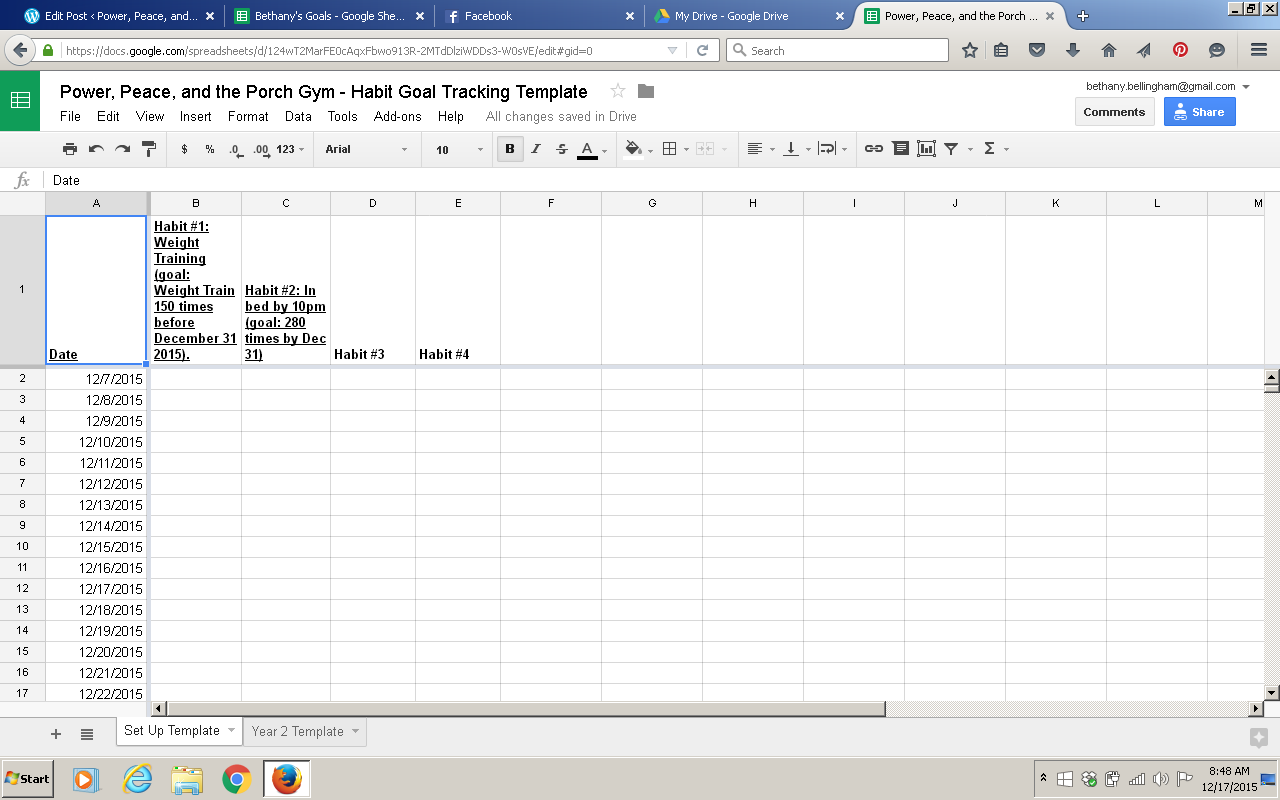
You can even copy my spreadsheet.

Screenshot 2015-12-17 08.48.01

Screenshot 2015-12-17 08.51.20

If you prefer to set up your spreadsheet from scratch, and can follow written directions well, here are the steps:

  1. Open a new document.
  2. Label the rows as follows: in cell A1, enter “Date.” This is your heading. In cell A2, enter your starting date (I highly recommend today’s date!). In cell A3, enter tomorrow’s date. Use your spreadsheet skills to drag it on down, so each day is the next day in the year. Stop when you hit the end date for your goal time frame.
  3. Label the columns as follows: in cell B1, enter your habit goal (example: Do a weight training workout 150 times by December 31). If you are working on a second habit (possibly not a good idea, but I did it and lived to tell the tale), enter that habit goal into cell C1.  (If/when you add other habit goals, you will enter them into  cells D1, E1, F1, etc).
  4. Go back to column A. Scroll down to the last row that is labeled with the end date for your goal time frame. In the row below that one, enter “Total”.
  5. Go to the “B” cell in that row. Enter a sum formula. (If you did your spreadsheet correctly, it will probably look like =SUM(B2:B365). The ending number may be a little different; just adjust the number to take all the cells into account. If you need help, ask me. Or ask someone good at spreadsheets that you know in real life.

If you are good at spreadsheets, put in percentage formulas below the total column. Then you will be able to see how close you are to accomplishing your goals.

Step 4 – Track Your Habit!

Once your spreadsheet is set up, here’s how to track your habit.

On each day, go to the row labeled with that day’s date. In each habit column, enter “1” if you did the the habit. If you didn’t do the habit, don’t enter anything.

THAT’S IT!!!!

If your sheet is set up correctly, your totals should calculate at the bottom in the “Total” row.

Step 5 – Adding More Habits

Another common question is “how often do you add new habit goals?”

I typically add new habit goals every 3-8 weeks, depending on how solid I am feeling with the habits already on my plate. The commonly quoted “it takes 21 days to make a habit” is not quite wrong; it’s more like a half-truth. It can take anywhere from 21 to 254 days to form a habit.

I have found that some habits are easier than others to establish. For example, remembering to take my Vitamin D was easy: once I added it to my spreadsheet, it gave me a daily reminder to take it, so that habit formed pretty quickly. Habits that take more time and planning may take more time to solidify. For example, movement habits or cooking habits may require more planning and more practice overcoming obstacles before they are really solidified.

My best advice is to be honest with yourself. How solid do you REALLY feel with your habit? Once you feel pretty solid, it may be time to consider adding a new habit. If you read Part I of this series and came up with a list of habits you wanted to try, just look at the list and choose the habit that you WANT to work on most, and add that one.  Go back to step 1, and repeat the steps as needed.

As I added more habits, I added them to my spreadsheet. You can even categorize and color code them, if it makes you happy. (See the second tab in the spreadsheet linked).


A Possibly Optional, but Highly Recommended Step

I’m not technically sure this step is optional, since I used it. I feel this step has been key to my success. However, I can’t swear that it MUST be used.

This step is practicing self-awareness. During the year, as you practice your habits, notice how you are feeling. Before, during and after doing your habits. As you track them. Always ask yourself if the habits are enriching your life, or making it worse. Adjust accordingly if needed.

If you are new to my blog, here are some of my previous posts on habits.  These will give you an idea of how the past year has looked for me as I focused on building habits, and where and how I used self-awareness to modify as needed.

This concludes my series on setting sustainable habit goals….for now. If you have a question I did not address, leave a comment! I’ll be happy to answer questions in a follow up post. Happy habit forming!


How to Set a Sustainable Habit Goal This Year: Part II

Welcome back! This post is Part II of a series on how I set my habit goals. If you haven’t already done so, read Part I first.

Step 2 – Choose a Time and Frequency Goal for your Habit

I answered a LOT of questions this past year about this step.

For all my habit goals, I defined a specific frequency and time frame. For example:

  • Do a strength workout 150 times this year.
  • In October, I set a goal to deposit $10 into my emergency fund 15 times by the end of the year.

One of the most common questions I am asked was “how do you decide how many times you are aiming to do your habit?”

How do you decide on a time frame?

I’m going to go over time frame before frequency, because that is easy.

I am a HUGE fan of doing a year-long time frame, for several reasons:

  • the whole persistence thing quoted in part I. If we feel we should be doing these things consistently over a long period of time, we should have a time frame that encourages that.
  • There are disadvantages to going with shorter time frames, such as the week (example: I’m going to go to the gym 3 times per week this year). Let’s be realistic here. We know that we are not going to do this EVERY week.  Some weeks we might go four times. We might get sick. We might get injured. The weather might suck. We might have to stay late at work to finish a big project. We might have to go on a business trip. We might take a few weeks to figure out how to overcome whatever obstacles were holding us back from doing it in the first place. A longer time frame allows for all of these things, while still allowing us not to get discouraged when we didn’t meet our goals EVERY week, because we are human.
  • It encourages patience and a macro-view instead of a micro-view. There certain habits that might be easier during certain times of year and more difficult during other times of year. A year-long practice encourages the development of patience and chilling the f*ck out and looking at the big picture….both when things are tough and when they are good. It eliminates the roller coaster of emotions that come with overhauling a lifestyle and then falling on your ass.

My first habit goals were set with a year-long time frame. Then, any subsequent habit goals were set with the time frame of “by December 31.” That way I could reset all the goals as needed at the same time, once per year. Your mileage may vary.

How do you decide on a frequency goal for your habit?

Here is what I did to figure out a frequency goal for each habit. It worked really well for me, as I am on track to meet most of my frequency goals by the end of the year.

First, ask yourself these questions (write down the answers):

  • How many times per week  am I CURRENTLY doing this habit? For many habits, the answer may be “inconsistently” or “not at all” or “some weeks I get 3 days, then for the rest of the month I don’t do any.” That’s okay. Make your best guess at an honest average. It is okay to put down “zero” or “less than one.” (Also, I know I said I am not a fan of the “per week” time frame, but bear with me here. It’s usually easier for most people to answer this question in terms of weeks than in terms of a year.)
  • How many times in an average week would I like to be doing this habit in AN IDEAL SCENARIO, if I was a perfect person with no obstacles to creating this habit?

Now, choose a middle ground between the above two numbers.

It should be a number that is more than what you currently do… and you should be 95% sure that you can actually attain this number over the course of the time frame you’ve chosen.

Before we move on to the next step, make sure that the number looks achievable for you. Be honest. Don’t be a type A person who bites off more than you can chew.  You are not aiming for perfection; you are aiming for consistency. Really look at that number and ask yourself if you are 95% sure you can achieve that.

But don’t overthink it. If you choose the wrong number, you can always adjust at a later date.

NOW…..convert that weekly frequency into a yearly frequency

Take that weekly number, and multiply it by 50. There’s your starting frequency.

That is not a typo. I know that there are actually 52 weeks in a year, not 50. And I also know that we all make mistakes when working on new skills, habits, and hobbies. In the case of water drinking, there may be fewer obstacles than say, going to the gym…..but you want to allow for them. The purpose of setting habit goals is to help improve your life, not to set unreasonable standards that make you feel guilty when you fall short. So, we use 50 and not 52 so we can allow ourselves a buffer for to allow for “life happening.”

What if I’m not using a yearly time frame for my goals?

Just adjust the number. Instead of multiplying by 50, multiply by the number of weeks (minus a couple) in the time frame you’ve chosen.

That seems like an awfully…..unexciting number.

I like to view these frequency goals as….goals, not maximums. If you meet your goal early, shoot for more at the end. You’ll be wicked proud of yourself. I sure am! Ask me how much fun it is to smash through goals in November, instead of giving up on my goals in January or February ;).

All right! If you’ve made it this far, you’ve probably:

In Part III, I will go over my habit tracking system, which I assure you is just as unexciting as my goal setting process, and just as effective. It also requires much less thought on a daily basis than planning and setting the goals!

Dear Parents Who Struggle With Self-Care

Dear Parents Who Struggle With Self-Care:

Are you feeling guilty about not taking better care of yourself (whatever that means to YOU)? Maybe you took great care of yourself (whatever that means to YOU) before you had kids, but now you feel pretty far off course?

I get it! The other day I caught myself thinking  “It is crazy how far off course I was from living a lifestyle conducive to self-care.” If you knew me when I was in my 20s, you would probably say the same thing. I was the most health-fanatical person of anyone I knew! Now, I’ve been working on habits that I would have considered pretty basic back then.  I would have thought that these habits were not nearly enough to maintain my health.

Continue reading

A New Habit. Somewhat conflicted, but it’s going well

A couple weeks ago, I added a new habit to my list: finishing my food for the day by 8pm. My goal was to do this 25 times by the end of the year.

Why did I choose this goal? I’ve been noticing that if I eat too much, too late, I feel uncomfortable while going to sleep. My sleep is not great and I thought this habit might improve it. Why only 25 times? Because I have a past history with any “rule” that sounds like a diet rule, and I didn’t want to put too much pressure on myself. I just wanted to start experimenting with this habit to see how it felt. 25 times amounted to roughly 3 times per week.  I was uncertain  as to whether focusing on this habit is a good idea in the first place. What if it sends me back to a dieting mindset?

I noticed those feelings and tried to address them. You don’t have to do it every day. The goal is 3 times per week. That leaves plenty of room for listening to your body. If you are  hungry and need to eat, go for it. It won’t mean throwing in the towel. If you didn’t get home in time to finish eating by 8, the goal is flexible enough to accommodate that. If you are watching a movie and want a snack for pleasure, not hunger….well, there is room for that too.

This is not about restricting myself from eating food that my body is hungry for. It’s about encouraging me to finish all that food early enough in the day that my sleep won’t be compromised by a full belly. It’s about noticing where I am in this process/journey of developing an intuitive eating practice…and noticing that I have made great strides with it during the daytime, and not as much in the evening. Therefore, it’s about giving myself an external reminder (the clock) during the time of day when I feel least likely to remember to eat in tune with my hunger and satiety cues. And since the goal is not perfection (but rather, 25 times by the end of the year), there is room for me to check in with myself and decide that I DO want or need to eat after 8pm on any given night for any reason.

Even acknowledging all of this flexibility, I still notice some uneasiness with this idea. Not necessarily in a “red flag” sense…maybe just in a “notice the sensation” sense that yoga teachers talk about when holding a challenging pose.

Continue reading

A Stream of Consciousness About Comparisons, Culture and Feminism

I wrote this post a few weeks ago when I was in a brooding/depressed mood. I was coming down with a cold, my friend’s mother had just been tragically murdered by an abusive boyfriend, and the weather was gray and cold and damp. I barely got up off the couch all day. The world felt heavy.

I say these things to give you an idea of the frame of mind I was in when I wrote this post. I was processing sad feelings all around. Since I’ve written the post, I haven’t felt like actually posting it, because the mood had passed and writing all of this out helped me process it to the point where I didn’t feel the need to share it. 

I’m posting it today. The reason why is too boring to write about, but I hope some of you enjoy or can relate to this!

Continue reading

Letting “Good” Beat “Perfect,” Kitchen Edition

They say that “perfect is the enemy of good.” I am applying that wisdom when it comes to cooking healthy, budget-friendly meals for my family this week.

I’ve decided to add a couple more habits to my habit list. One of these habits is cooking a beans and rice dish 6 times by the end of the year (roughly once per week). (If you have a favorite beans and rice recipe, please drop me a link!)

Continue reading

The Porch Gym Moves Indoors

It’s raining today…..so instead of taking a walk, I moved all my weightlifting equipment across the room and moved furniture around!

I had been lifting on my porch all summer…and now the weather is starting to get really unpleasant. I bought a heavy duty gym floor mat to protect my hardwood flooring. But last week when I set it up in my living room, I was really conscious of how I was not enjoying myself in that space at all. Surrounded by clutter and toddler dirt. Weightlifting is a hobby I love and I like to respect the space.

This past Tuesday I noticed the same thing: I did not want to lift in the living room. Something had to change.

Soooo….I rearranged all the furniture and made space for my equipment (it had previously lived near the door because that was convenient for lifting on the porch. Now I feel like I have a designated corner of the room for lifting, instead of feeling like I am in the middle of furniture and clutter. I am going to try lifting later and see if it feels any better. I think it will!

It won’t win any interior design awards, but I think it will help functionally. I have been struggling with motivation lately, so I need all the help I can get, and that includes liking my environment.

I’m feeling proud of how my self awareness is improving. Listening to your body can mean more than just listening for hunger, satiety, and sleepiness cues.

I’m also feeling grateful of all the discarding we’ve done – because it allowed me the space to move my porch gym into the living room for the winter. Not everyone has a ton of spare room in their home, and I’m glad I found a way to work with the space I have.